

Lovable is doing something objectively interesting. On their way past $400M ARR with an incredibly lean team, they leaned away from increasingly saturated and expensive distribution channels like paid marketing and organic search and into a strategy they call “Employee-Led Socials”, effectively turning the people inside the company into an organic distribution network.
And I agree – this is an extraordinary distribution asset.
Distribution is however only half of it. Because every employee talking about the brand in social media is also contributing signals about what Lovable means. The brand potential is undeniable, but so is the need for coherence.
If you rolled out the “Employee-Led Social”-approach tomorrow, would your employees collectively strengthen the meaning of your company or would it reveal that nobody inside quite agrees what it is?
Enter the “Fish-vs-Shark” approach.
In a 2010 ad, Accenture shows a school of small fish arranging themselves into the shape of a shark.
For the fish to form the shark, they must somehow know where to swim. Employee-led distribution exposes whether people inside the business genuinely share an understanding of what the company means. And social media just makes that internal condition observable.
You see, no single fish looks like a shark. The shark exists only at the level of the collective. One employee post is just one employee post. But when 45 people consistently post related signals, the pattern begins to outrun the individual parts.
And just because the fish start to coordinate, they do not become more powerful on an individual level. What happens is that their coordination changes the meaning they are sending. Their relationship to one another changes how they are interpreted. The fish cannot declare themselves a shark. Someone looking at them has to see one.
And scale changes this game. The strategy that works brilliantly while cultural knowledge is shared among the few becomes increasingly dependent on an explicit organising principle as the organisation expands. The alignment therefore has to exist before anyone starts thinking about what to post.
When people share a clear enough understanding of what the company means, they can make very different choices about what to say and still move in the same direction. At scale, those individual choices start adding up to something larger. You are decentralising hundreds of small decisions that shape how the company is perceived. What is worth talking about? What do we pay attention to? What feels natural for us to say? What would feel completely wrong? Each decision is made individually, but the meaning they create is collective.
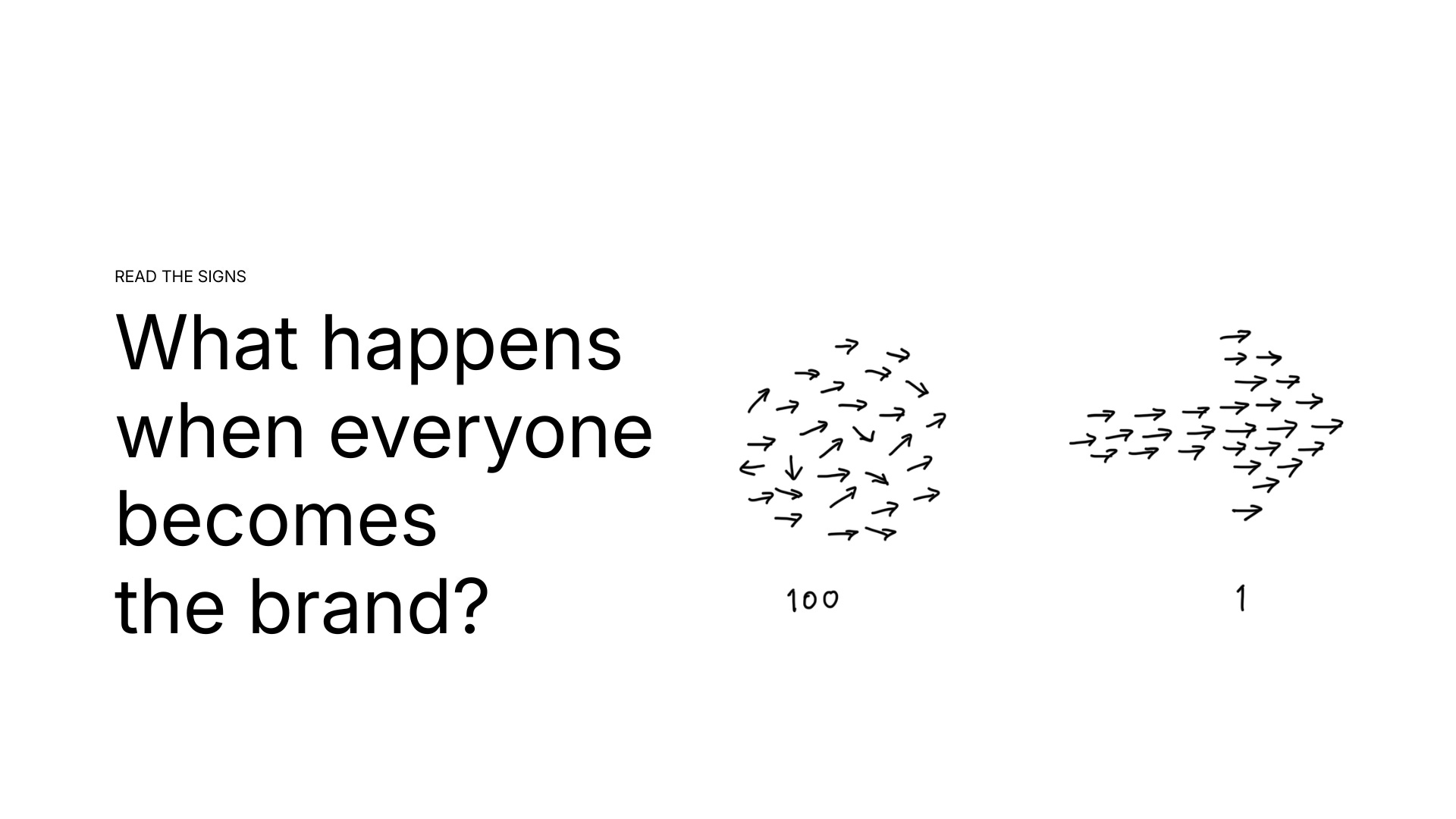
So what I am saying is this: distribution without alignment produces fish, not a shark.
You can give 100 employees audiences, content support and posting systems. If what they collectively signal does not resolve into something recognisable, you have increased the reach of the brand without increasing the strength of the pattern.
The power appears at the level of the pattern.
Read the Signs looks at how individual signals become collective meaning. And what happens when everyone starts sending them.