

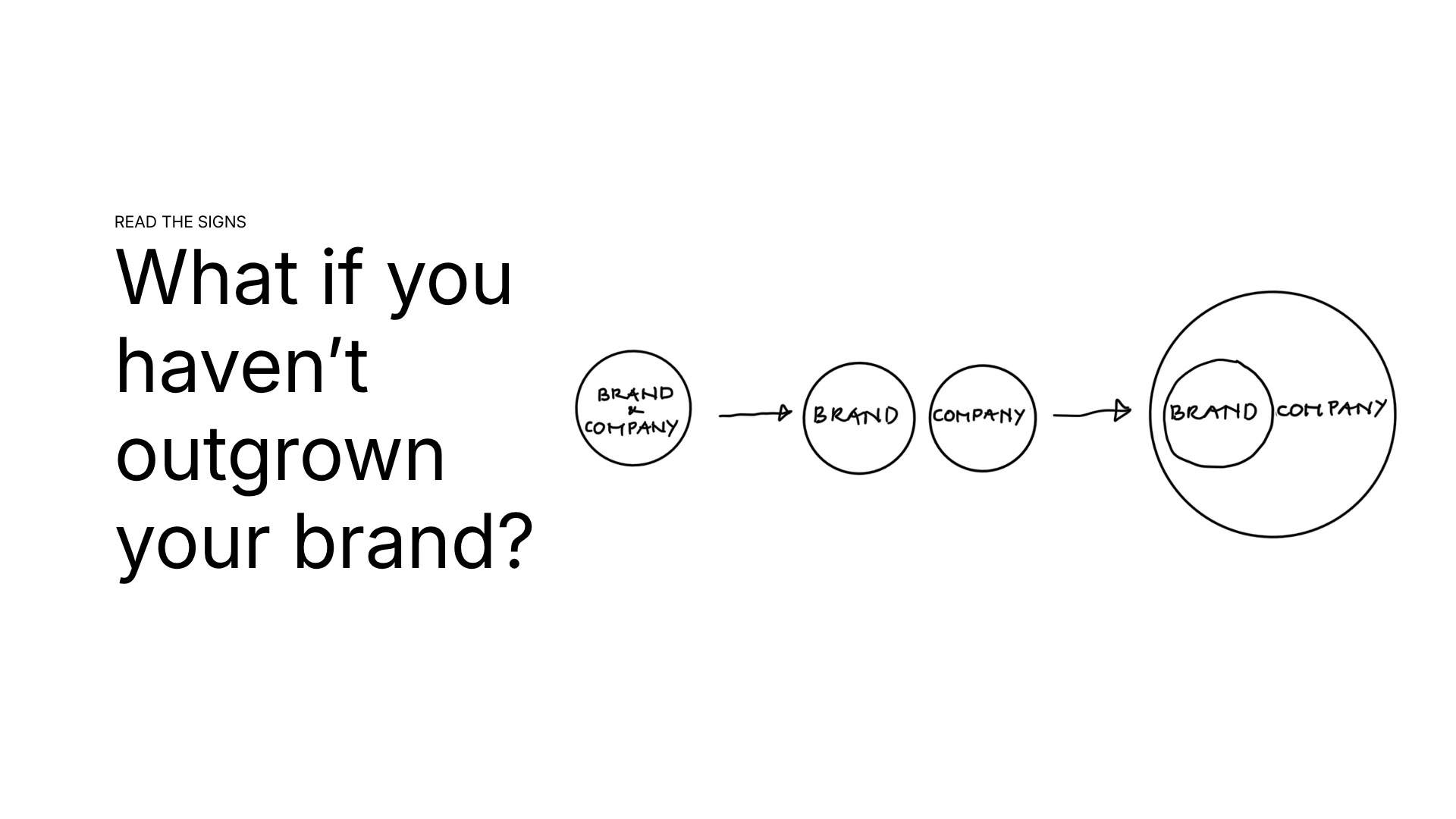
Have you ever said, or heard someone say, “We’ve outgrown our brand.”
It sounds like a diagnosis. But it isn’t. All it really tells us is that the company and the brand have moved apart.
And that can happen for very different reasons.
The company has grown. New offers have been added, new markets entered, new capabilities acquired and new ideas are probably already brewing that could reshape the business again.
According to PwC’s 29th Global CEO Survey, 42% of CEOs say their companies have started competing in new sectors or industries during the past five years. And among CEOs planning at least one major acquisition in the next three years, 44% expect to make deals outside their current industry. These companies are not simply getting bigger. They are changing shape.
So when the brand starts feeling slightly out of sync with the business, updating it can seem like the obvious next move. I wouldn’t be so quick.
Two things moving apart only tells us that there is now a gap where there previously was none. It says absolutely nothing about whether or not one has moved in the right direction. If either did.
I see at least three possible diagnoses.
01. The obvious one: the brand has fallen behind.
Sometimes this is exactly what has happened. The company has consciously changed the position it wants to occupy. Its strategic centre of gravity has moved. What the business wants the market to understand about it today is genuinely different from the meaning the existing brand has accumulated.
In that case, yes, the brand may be optimised for a company that no longer exists. And the brand needs to move with it.
02. The opposite diagnosis.
But say the company became successful while standing for something unusually clear. Something the market understood. Something distinctive enough to accumulate meaning over time.
Then perhaps the company is the one that moved.
Not because anyone decided to abandon that position. Drift is usually less dramatic than that. The business simply keeps making sensible decisions in response to what happens next. Each one is easy to justify at the time. In fact, that is rather the problem.
But direction can change by degrees. And by the time the pattern becomes visible, the company may already be somewhere nobody consciously chose to go.
This is why I would be careful with a rebrand.
Because if the brief becomes “make the brand reflect everything we are today” the new brand may end up doing something much more consequential: it may turn strategic drift into something that looks deliberate.
Once the brand has been rebuilt around everything the company has accumulated, all those decisions suddenly acquire the appearance of a strategy.
Perhaps they do. Perhaps they don’t.
I know I would want to find out before spending a considerable amount of money making them look coherent.
03. And then there is another possibility altogether.
Perhaps we are expecting the company and the brand to overlap more than they need to.
Really? Really.
A company can become considerably more complex without what it means becoming equally complex.
Every time a company grows, it acquires more things it could say about itself. And at some point, trying to make all of them equally representative starts making the brand less specific.
So here is a somewhat counter-intuitive proposition:
What if the bigger a company becomes, the less of the company its brand needs to represent?
When a company is small, the business and the brand can almost overlap. What the founders believe, what the company sells, how it behaves and what customers understand may all sit very close together.
Growth changes that.
The company becomes capable of being many things at once. The market, however, still has to make sense of it.
Which means the role of the brand may change as the organisation grows. Increasingly, its job is to filter what gets to define the whole. The brand does not need to explain everything the company does. But it does need to be absolutely clear about what the company as a whole is supposed to mean. Inside the organisation. And outside it.
That would give the brand a very different role in growth. Not to keep expanding every time the company expands, but to become increasingly selective about what all that growth is allowed to mean.
Growth gives a company more things to say.
It doesn’t necessarily give the brand more things to mean.
Read the Signs looks at the signals companies accumulate as they grow. And which ones get to define the whole.