

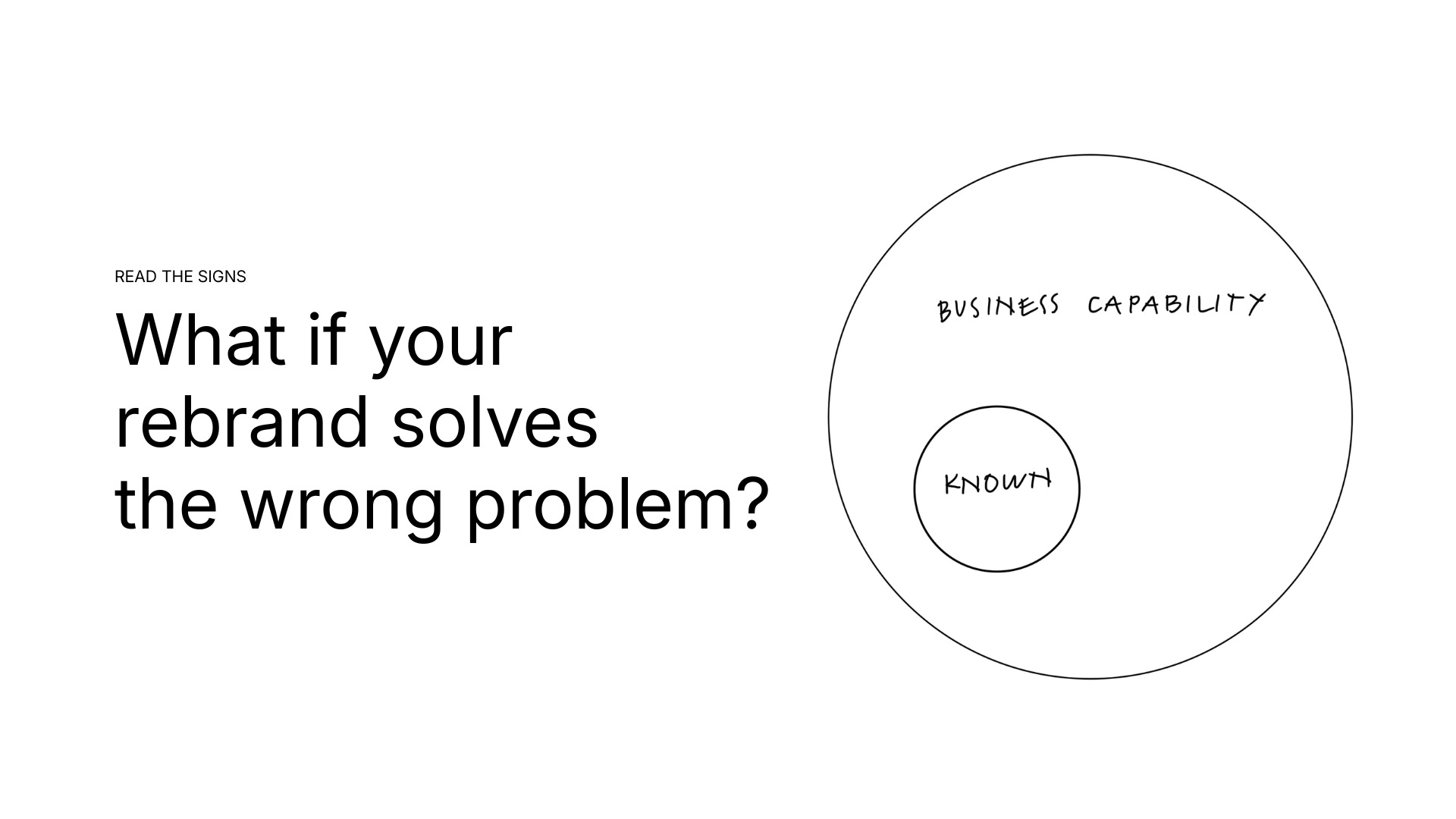
Let me start this week by being somewhat blunt. A rebrand won’t solve your brand problems if you’re solving the wrong problem to begin with. I have sat in enough rooms discussing brand and business development where the discrepancy between what the company now can deliver upon and the market’s perception of it IS the problem at hand. But where a rebrand as in “we will change our brand expression (how the company looks, sounds and behaves) to become someone new” IS NOT the way to go.
I get it though, it is easy to start talking about a rebrand when the urge of changing something grows strong. And quite honestly, if you bring in an agency of any kind, that agency will set you on a path of making their expertise the solution to your problem. (So choose wisely.) Sometimes the conversation is quickly moving towards naming, logo, colours and/or visual identity and the important discussion about whether or not their positioning is right or not to begin with is completely overlooked.
Before we begin today, let’s just settle on what a brand is. This is my way of defining it: A brand is the collective meaning the market constructs from your products, services, communication, behaviour, history and customer experiences.
So the real dilemma here is about
A) Changing what the company means, because the market is no longer supporting your ambitions. This means that you might have to change your positioning to be able to compete for other types of clients/customers, in new categories or on other terms.
B) Change what the market believes you are capable of delivering upon. In this scenario you already have relevant associations and established credibility, but the market is unaware of your full potential, range of offerings, or competence.
In alternative B, you have valuable brand equity worth keeping and further developing.
Both of these alternatives may need changes in your communication and design, but the strategic starting points are very different. They are also not mutually exclusive. As the market starts to believe in your new capabilities, the meaning of your brand may develop as well.
Take an accounting and advisory firm as an example. For the last decade, they have been laser-focused on developing their expertise, hiring new talent and broadening their range of services. What started as a traditional accounting firm has evolved into a company capable of advising clients on much more complex and strategic business decisions.
Inside the company, EVERYONE knows how much the company has changed. It is just unfortunate that it has been kept a secret from the market. And the consequence? The company receives the same types of enquiries about accounting and compliance, is compared with the same competitors and is approached to do the same kind of work as before.
Don’t get me wrong, there’s considerable value in being known for something. But when the market keeps coming to you for the same things it always has, your reputation may be limiting the opportunities you’re even considered for.
Say that this hypothetical accounting and advisory firm is strongly associated with competence, accuracy, knowledge and mastery. Its signals might place it in the Power & Mastery territory of Field of Meaning®. And say that the ambition of its leadership is to be seen as an innovative, transformational, leading-edge company. Then the perception of the company will have to move into the Innovation & Transformation territory, right?
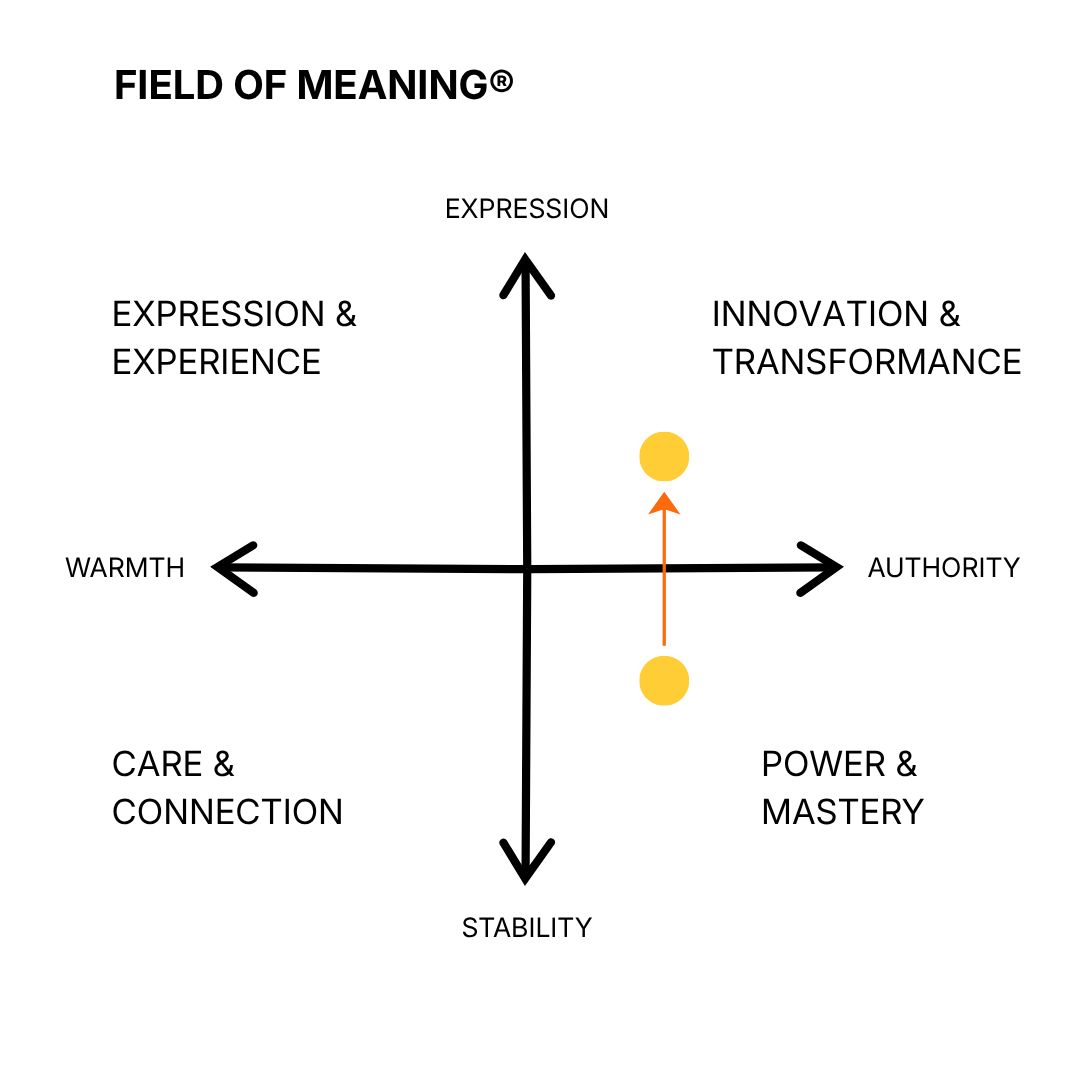
The Field of Meaning® is my proprietary brand intelligence model. By analysing the signals a company sends through its communication, identity, offerings and behaviour, it helps map the meaning the company projects, how that relates to its competitors and where opportunities for stronger positioning may exist.
It depends.
I know this is a very unsexy answer, but it really does depend on the situation. Here’s why. You can either be restricted by the associations from the market to authentically establish credibility within your aspirational category, and if so – you actually need to change your strategic positioning. OR your current competence, accuracy, knowledge and mastery is exactly what makes these innovations credible. And IF SO, it could be much more profitable for you to make this connection more seen and felt than just abandoning your present position for something new and sparkling.
There are basically three risks you have to consider when deciding upon what type of a problem a rebrand would solve for you.
RISK 01 – Changing too much.
What if you have spent a decade or more establishing recognition, trust and distinctive associations. PLEASE do not run from this without a proper analysis. It is so easy to feel like “we need to modernise our look” and then come out on the other side looking generic or too much like your competitors. And even if you don’t, you might end up investing a lot of money into rebuilding that recognition, trust and distinctive associations you already had in the first place. That’s the basic definition of a waste of time and money…
RISK 02 – Not changing enough.
If you need to change how the market perceives you, changing the visual identity might raise some attention to your new logo, new website and new tonality. But if that’s the only thing you change, the people coming into contact with you might not see the difference in your potential performance. You still have to change the signals giving you permission to act in this new capability, or else your commercial limitation will remain intact.
RISK 03 – Promising more than you can prove.
A brand audit may come to the conclusion that the company has a lot of underused potential that they could explore to step up their game and grow. Significantly. It doesn’t mean that the organisation is ready to deliver upon it. Relevant client cases, documented results, demonstrable expertise, operational capacity and/or experience of this new category may be missing.
Say that you want to be perceived as a strategic transformational partner, but you are still only capable of delivering technical solutions. In this case, a rebrand could increase the expectations faster than the organisation develops its abilities to deliver on it. Then you might create a trust problem. And the louder you beat the change drum, the more obvious the gap between your promise and your delivery becomes..
Instead of telling the market you have changed, change the business reality first. Just because the position is strategically attractive doesn’t mean the market will allow you to occupy its place.
So, what decision do you need to make right now? Let me give you the same advice I will be giving a client of mine as soon as my brand audit of their rebrand is presented:
“Start by looking at what existing brand assets are creating value for you today, and which might be holding back your growth. Then choose what to keep, what to strengthen, what to develop and what to change in order for your company to grow.”
You might discover that the most valuable thing about your next rebrand is what you decide not to change.
Read the Signs. Your next chapter may depend on what you decide to bring with you from the last one.